


Backend Development with NestJS and TypeORM
 Mahabub Hossain
Learn how to build scalable, production-ready server-side applications using NestJS and TypeORM — from project structure and modules to database relations and migrations.
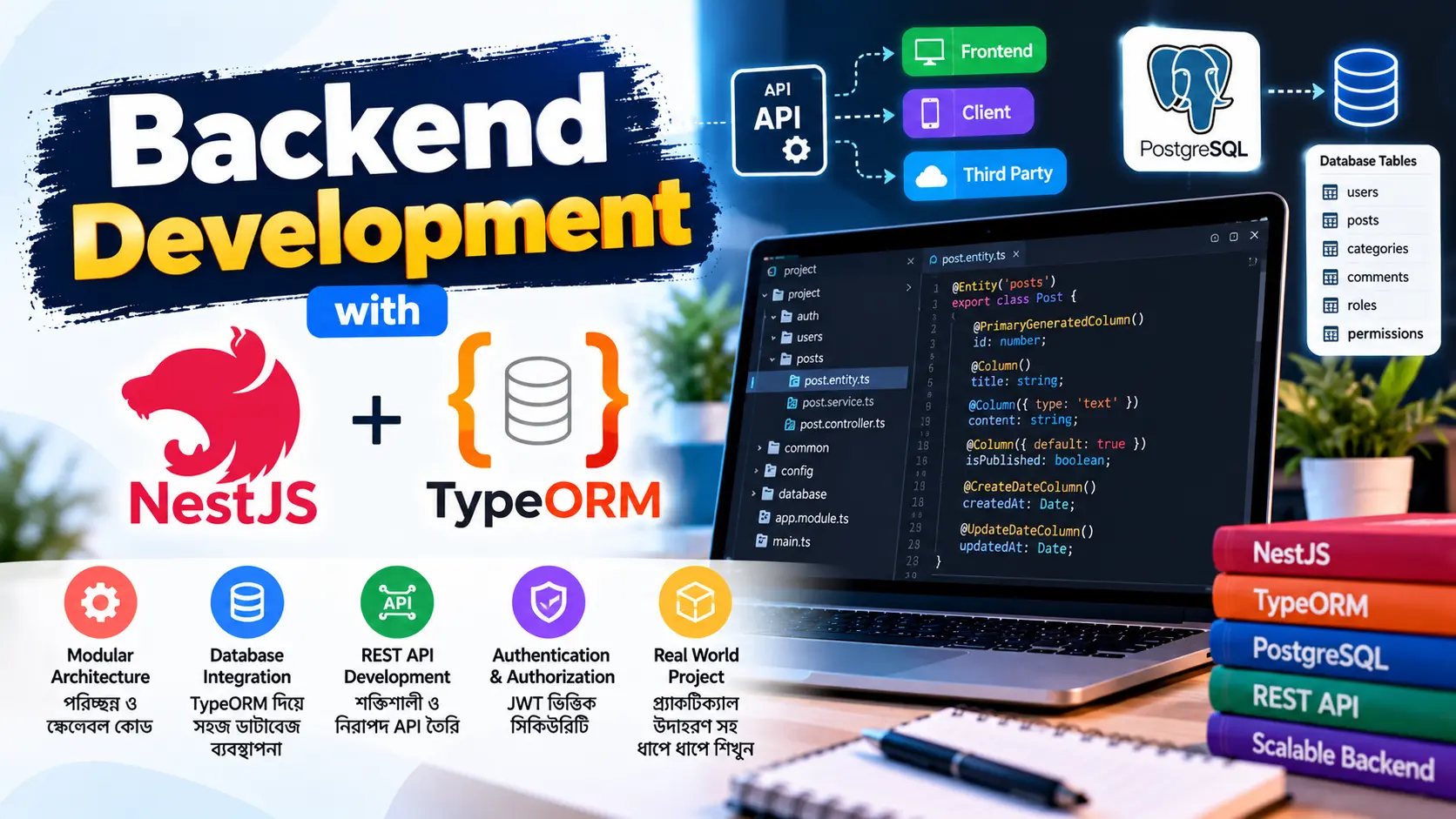
Backend development is the backbone of any modern web application, and NestJS has quickly become one of the most popular frameworks for building it. NestJS is a progressive Node.js framework built with TypeScript that uses a modular, decorator-based architecture inspired by Angular. Its structured approach — modules, controllers, providers, and dependency injection — keeps large codebases clean, testable, and easy to scale.
TypeORM is the natural companion to NestJS for database work. As an Object-Relational Mapper written in TypeScript, it lets you define your database schema using entities and decorators, then query it with a fluent repository API instead of raw SQL. Relations such as one-to-many and many-to-many are declared directly on the entity classes, so the database model and application code always stay in sync.
Together, NestJS and TypeORM give you a complete backend toolkit: REST APIs with built-in validation pipes and guards, database migrations for safe schema evolution, and first-class support for PostgreSQL, MySQL, and more. Authentication with JWT, role-based access control, and DTO-based validation all follow well-established patterns that are documented and battle-tested.
In our Backend Development course, students build a real-world project step by step — setting up a NestJS project, designing entities and relations with TypeORM, implementing CRUD endpoints, securing routes with authentication, and finally deploying the API to production. By the end, you will be able to design and ship a complete, professional backend on your own.